Talking dirty: quitting and failure

I recently did a mountain bike race with a friend, who had crashed out and quit part way through. When I found out that the crash hadn’t precluded him from carrying on, I innocently asked why he’d stopped, and he got defensive about it. So then I asked him why he was getting so defensive (I can be really annoying), and he said he didn’t know – since the only reason was that he’d just felt done for the day and had nothing to gain by carrying on.

Another friend of mine quit a trail marathon a while back. When I asked her why, she said she had good reason – it was a C race for her, it was pouring down, she was soaked head to toe and freezing just a few miles in and just didn’t think it was fun anymore. She quit out of misery; she knows it was the right thing for her to do at the time; but she’s still “bummed I quit”.

The one and only time I’ve ever quit a race was at the CRCA Bear Mountain Classic, in 2018. I lined up at the start in a cesspool of negativity – tired, coming off a string of bad races, and fully expecting to “fail” (hills aren’t my thing). No more than 15 minutes later I’d got dropped on the first hill and stopped biking, my heart pounding through my chest, my mind and body crushed with defeat. I saw my husband riding towards me and, with tears of failure welling up inside, turned off the course and into the comfort of his draft.

Were my friends wrong to quit? Was I wrong to quit? Why?

To put my conclusions first: no; yes; and, depends on what and why you’re quitting.

What are you quitting: by which I mean, what was your goal to begin with? What improvement were you trying to make? Are you quitting an outcome, or the journey?

For example, let’s suppose it’s for a specific placing. Pros quit races all the time. If their goal is to finish in the money and quitting on a bad day means they save their body for a good one, then that makes sense.

On the other hand, let’s suppose your goal was to finish a race as best you can. Do you want to quit because you think you have “failed” your goal? Then – even if you’re missing a hoped-for time or placing – then quitting can often deprive you of a perfectly good learning opportunity. If it’s so hot you can barely think, or your legs are so tired you’re pedaling squares, or that nasty mid-race hill gets the better of you, then maybe it’s worth figuring out how to deal with that. What does your body and mind need to be able to get through those circumstances? Adversity is a great teacher, and in my view at least, the better someone can manage adverse conditions, the more respect they deserve as an athlete.

Why are you quitting: are you physically suffering to the point where if you continue you could get sick or injured? If yes, then quit. Are you suffering in a way that will ultimately have negative, not positive repercussions – i.e. the suffering outweighs any benefits you could possibly hope to get out of the race? If yes, then quit.

Do you have that voice in your head that says, “I just can’t do it. I need to stop”? If yes, then hold on. As postulated by the central governor theory your brain will signal you to stop as a way to protect your body. Put another way, allow for the potential that you can do more than you thought. Are you quitting because you feel miserable and defeated? If yes, then hold on. Learn to pick yourself up off the road. Look for solutions to keep going. Stay positive.

To quote from the poem “If”:

If you can force your heart and nerve and sinew
To serve your turn long after they are gone,
And so hold on when there is nothing in you
Except the Will which says to them: ‘Hold on!’

Back to the opening examples.

My first friend is an expert mountain biker. He was in the race to win and at the same time had nothing to prove, having won it the year before. The crash was bad – it took him a decent amount of time to figure out how far he’d somersaulted from his bike, make his way back to the start, un-mangle his bike handlebars and get back on. Was he fine to continue, medically speaking? Yes. Could he have gained some incremental fitness benefit by carrying on? Sure. Did he demonstrate a lack of tenacity by not doing so, thereby rendering himself a “bad quitter”? Hell no. Tenacity is his middle name. He simply felt somewhat shaken by the crash and didn’t have his head in the game after that.

My second friend is a top age group Ironman competitor and also tough as nails. It would have been great if she’d completed the race, as it was a new experience and a perfect early-season fitness-builder. But if you’re at the point where you’re so cold you’re physically unable to push your body in a healthy way, then seriously, just stop already. And if you’re not having fun in a race where your primary goal was, in fact, to have fun, then how about you just table it for another day…

I was at the start line of a race that would have increased my fitness had I worked hard and finished, whether on the back, off the back, or even waaay off the back for that matter. I had come to the start line defeated before I took my first pedal stroke and failed to find the mental fortitude to overcome it. Worse still, my misery was driven not by physical discomfort or injury, but by a narcissistic and misplaced presumption that being off the back would be utterly shameful.

To quote “If” again:

If you can meet with Triumph and Disaster
And treat those two impostors just the same…

Right on. I quit because I was unable to do that. That was a fail.

In the end, I really like the way my coach puts it: you need to find “just the right amount of striving”. Not so little that you throw away the potential for gain; not so much that vainglory trumps real achievement.
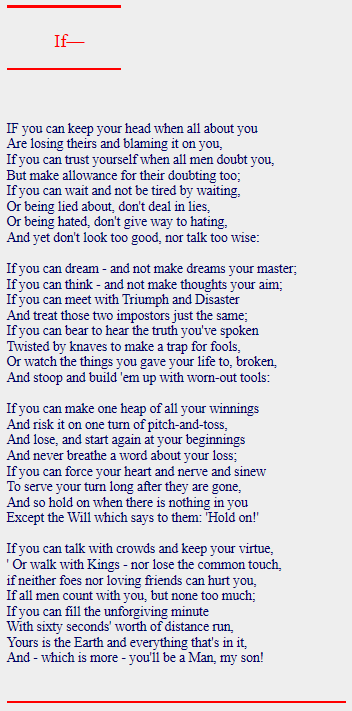
“If” by Rudyard Kipling

Overcoming obstacles – muscle versus technique

I was recently struck by a confluence of lessons learned between my strength training and my career development, specifically in relation to pushing through difficult situations.

Wednesday evening I had strength – heavy lifting. I work hard on my strength technique. I like to think I know what good posture looks like and how to implement it. This evening was a total fail, however. I was given a new type of dynamic workout – I had to leap forward, landing on one leg then the next, keeping total stability to land balanced before immediately generating power for the next leap. With a resistance band around my ankles. This is hard…if you don’t have core locked, hips aligned, butt engaged, knees bent, chest up AND trailing leg activated then from what I can tell, you’re basically going to either fall over or not really go anywhere fast in a forward direction.

“I don’t get why I’m so unstable”, I moaned to my trainer. “In my head I’m doing all these things, so why am I so rubbish?”

“Well, a) you’re actually not doing all those things, and b) you’re trying to muscle through the movement instead of locking your posture in and using it to generate momentum. So, you’re losing power and stability left right and center.”

Well phooey. So much for having great technique. One ratchet up in exercise difficulty and suddenly I’m a wobbly mess.

The next day, I had a one-on-one with my boss. I’m up for promotion to Director this year; I wanted his feedback on where I needed to improve in order to be effective in such a role. He pointed out that while my tenacity and drive were strong, my ability to accommodate deviations from my intended plans was weak. In other words, I needed to get more creative about overcoming obstacles, as opposed to just ramming against them as hard as possible in the hope they’d eventually collapse.

Hmmm. That sounds familiar…. is that a little theme emerging? Muscle versus technique…clearly you need both, but the former will only get you so far. A stationary position allows force to overcome a myriad of weak links. Add in a dynamic environment – competing priorities, shifting objectives, difficult colleagues, plyometric jumps…and those links will get tested. In the context of strength, these are posture and flexibility. In the context of work, these are communication and adaptability. In both cases, having a strong core, or center, and finding calmness at that center is key. I think of it a bit like being in a hurricane. You want to be in the eye of the storm, not the swirling clouds.

I’ve learned that curiosity is the key to keeping that center. Acknowledge and try to understand the problem, don’t try to fight it. Put another way, it moves the conversation away from “this so hard for me” (negative) towards “why is this so hard for me and how do I overcome it” (positive). Sometimes, that may mean taking a couple of steps back before you can move forward again. But that’s OK.

In the end, I spent about half our one-on-one waxing lyrical about the parallels between work, cycling and strength. Happily, my boss didn’t seem to mind too much.

Finding just the right amount of positivity

One of the hardest things I had to contend with when getting into bike racing was negativity. There’s plenty of opportunity for it.

First, with such a small community of women racers, your placing is visible to all and people care…this is strange when coming from the world of triathlon, where it’s all about your personal effort and you can literally have no idea what position you’re in from start to finish of a race. That’s pressure right there. Then there’s the whole “you have to get picked for a team” thing (I thought I could pick one, just like a running club!) that had my anxiety through the roof. Then there’s the misery that is being positioned well for the entire race, only to completely blow it in the last 200m. Or just not quite being able to hold on, and off the back you go. That doesn’t happen in triathlon either. Yet more reasons to feel crappy about oneself.

The key is, to come in with the right attitude; “right” being the one that keeps you calm, motivated and enjoying the sport. For me it’s about staying focused on my goals & not letting my competitive monkey brain get the better of me. It’s about remembering how much bloody fun it all is…it’s also about “positive thinking”, defined most broadly as having an optimistic attitude.

There’s a mountain of articles out there about the benefits of positive thinking. It improves quality of life, resilience to bad situations, and improves the mind’s ability to learn. From an athletic perspective it can directly improve your race times.

Some classic positive thought mantras for races are “I can do this”; “shut up legs”; or “this is what you came for”. I personally don’t find that these kinds of mantras help me that much though. Trying to believe in them feels like I need to do this big mental leap which drains me of energy. I can’t seem to link the intellectual sense of positivity to any physical one; in fact such thoughts take me further away from what my body is feeling, and once I lose that connection, I find hard efforts exponentially more difficult.

The self-talk that works for me is a little more neutral. I seem to gain most strength from observing and accepting what I feel. For example, during a race I’ll think, “hmmm, the pain in my legs is truly horrendous”, or “f*ck this f*cking sh*t, I should have just stuck to running”; but then I’ll think, “OK, so what can I do about that?” And then I just do it.

I perused a few articles on the subject and found some which could potentially explain this. I found two studies, here and here which explain how mental fatigue can undermine athletic performance. In addition both the former of those (in paragraph 3.4.5) and this one discuss how emotional suppression can hinder performance. For me, trying to “think happy thoughts” whilst dying a slow death in zone 6 most definitively constitutes emotional suppression.

Positivity to me means, not being defeatist, but focusing on the present and what I can control to keep going. Maybe it’s a rather British understated type of positivity; but in any case, it works for me.

Why cyclists should drink more tea

Why yes, I am British…big week for me in April though – I become a Citizen of the U.S.A. In honor of this event and in remembrance of my former home country, I’m posting something British-y.

Cycling is famed for its coffee culture. It’s a big difference to the cult of Ironman training, where you’re not supposed to stop for any length of time during your 6-7hr long rides – after all, you don’t get a coffee break on race day. I used to frown on “muffin rides” with a confident air of superiority. Cycling – if you don’t stop, you’re an uncultured a**hole.

I can live with that – Coffee is Good. But I am partial to a nice cup of tea when I get home, I must say. Especially after a winter or early spring ride, when there’s a chill in the air, I like to come home, get that recovery drink down, then warm myself up from the inside while I stretch/shower/clean my bike down. Even on a summer day a hot tea is surprisingly refreshing and indeed there is research to show that in the right circumstances (a dry, not humid heat, when your sweat is able to evaporate), a hot cup of tea will help cool you down. And in the humidity of the east coast you can always prep the iced variety.

Now, let’s be clear– the type of tea we’re talking about is important. If you’re after pure hydration, stick with herbal tea (or “tisanes” to give them their Proper name). Caffeine is dehydrating. Certain types of tisane will also impart additional benefits. I like to make fresh lemon ginger tea where I simply cut up a ginger root, add lemon wedges and steep in hot water; ginger being an excellent anti-inflammatory agent & digestive aid, & lemon being an immunity booster. Peppermint is known for its digestion benefits; the list could go on.

If it’s been a long ride – and especially if the clock’s hit 3 or 4pm, you still have laundry to do, errands to run and dinner to get on the table – then a pot of black or green tea could be just the ticket.  

On the question of milk

If it’s black tea, then you can and should add milk (but do be sure to add the milk in the cup first. If it’s a tisane, then – with the single exception of golden milk tea – please don’t do this. I recently got served a mug of lemon-ginger tea at work – with milk – on the premise that I was British and would therefore Want That.  Pants.

On the question of accompanying biscuits

Yes; and, Hob Nobs.

On the question of adding alcohol

Yes, most especially after a cold ride when your thermal sock-plastic bag-thick bootie-kit still left you with numb feet. Type of tipple depends on the type of tea.

Black tea – add rum. This one originated with the British Army in the 19th century and is otherwise called a Gunfire cocktail.

Green tea – I would tend toward a white spirit; a nice floral gin for example.

Lemon-ginger tisane – bourbon! Not only yummy, but also smart, as “clearly” the drawbacks of drinking alcohol will be more than offset by the benefits of ingesting lemon & ginger.

In all cases, pour a cheeky amount.

…and finally, if you’re really keen

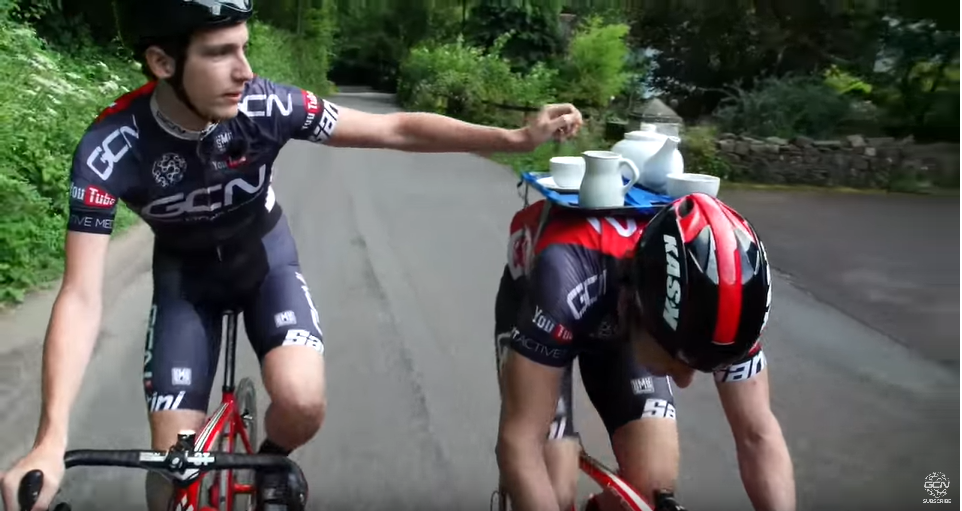
Then get your domestique teammate to work for you like this:

Genius

All about brake cable tips

Learning about The Bike – where to start? It’s a pretty big subject…I faithfully use GCN Tech as my starting point, but I do like to dig deeper on various topics…then I end up tunneling around a rabbit warren-full of information and getting fully overwhelmed. So, I thought I’d start my first “technical” blog post with something as small as I can think of – brake cable tips – and see how many words I could get to.

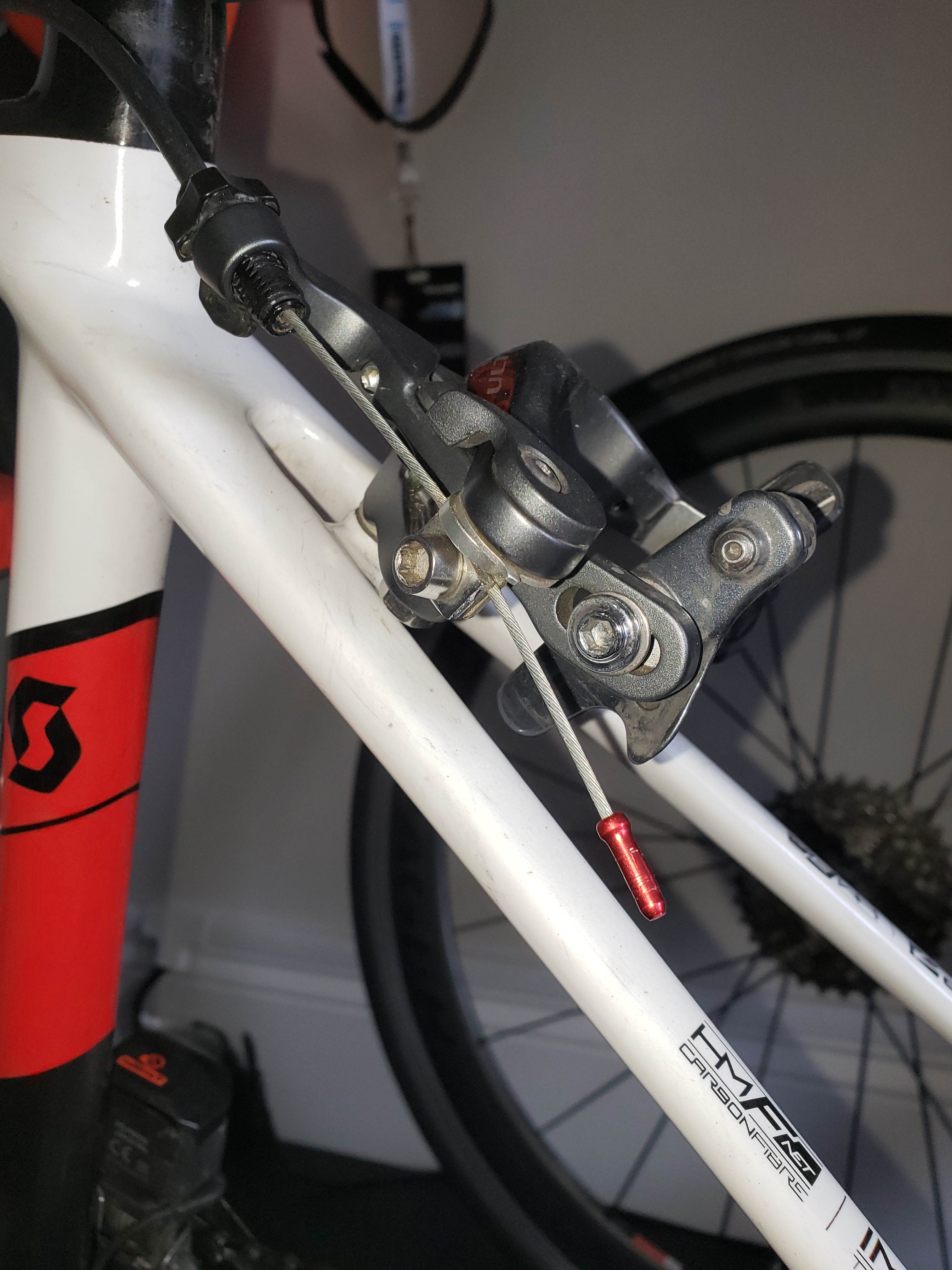
I became unreasonably excited by cable tips during Tucson bike camp, where the mechanic noticed that I didn’t have one and gave me a red shiny replacement, which I loved because a) I hadn’t noticed their existence before and b) I didn’t realize such things could come in different colors. As a result, this is now officially the favorite thing about my bike.

My brake cable tip – sexy or what??!!

The very basics of bike cables

Bike cables – for both braking and shifting – are types of Bowden cable. They are comprised of an inner cable made of twisted strands of steel moving inside of an outer housing, also made from steel. The basic idea is that when you pull on the inner cable, it pushes against the housing, thus creating tension between the two and allowing the cable to move in a non-linear path between components. The housing also has a plastic liner which surrounds the inner wire and reduces friction between the two.

Cable tension is adjusted using the barrel adjuster, which lengthens or shortens the cable housing relative to a fixed point. Lengthening the housing forces the inner cable to travel further, effectively tightening it.

The traditional cable housing is comprised of steel wire wound into a helix (like a mini slinky); since this allows the length of the housing to change as it is flexed, it is a source of imprecise shifting. Thus, shift cables use a modified type called compressionless housing. This uses many inner support wires running parallel to the inner plastic liner, which prevent the length to change.

The housing will usually be encased in a plastic sheath to prevent corrosion.

The Jagwirewebsite has some nice diagrams of the different types of inner wires and cables available.

What are cable tips, and why do we need them?

A ferrule is defined most generally as “a ring or cap, typically a metal one, which strengthens the end of a handle, stick, or tube and prevents it from splitting or wearing.” Within the context of bike cables, a ferrule is a small cap which fits over the end of a piece of cable housing. It helps keep the housing aligned with the cable stop it fits into, for example the barrel adjuster. A brake cable end, or tip, is also a type of ferrule. Since the tip is normally affixed around the end of the wire by crimping, these are also referred to as “crimps”. Cable tips are typically made from aluminum.

A cable tip is important because it prevents the cable from fraying or unraveling and from scratching you.

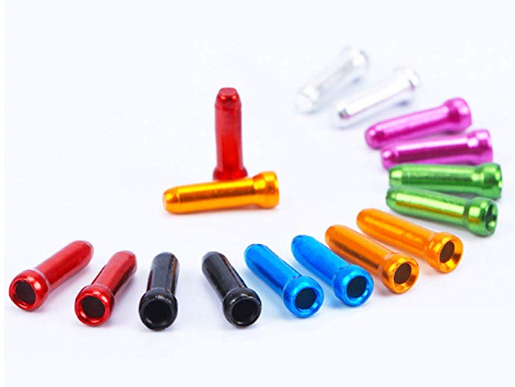
I love how some bright color makes these mundane little pieces fun

How to crimp a brake cable

Step 1. Thread inner brake cable through the barrel adjuster and the crimp part of the brake caliper; tighten to your preferred tension using the caliper bolt.

Step 2. Find an appropriate cable crimping tool:

  1. A dedicated crimping tool such as this one. This is if you really want to be neat and not deform the cable cap
  2. A cable and housing cutter with a built-in crimper like the CN-10 from Park Tool
  3. A pair of pliers

Step 3. Find some sexy-looking crimps in a color of your choice

Step 4. Crimp away! Fun fun fun

Crimp alternatives

The alternative to crimping is to solder the wire ends. The advantage of soldering over crimping is that it allows the cable to be pulled through the anchor bolt and housing to reinstall or re-lubricate it, rather than be removed and replaced with a new one every time you disassemble and reassemble a cable. The disadvantage is that the heat can weaken the steel, and it also seems somewhat less practical or simplistic. A second alternative I read about is to super glue the ends…but that just doesn’t seem like the elegant way to go.

Finally I did notice these fancy-looking cable tips from Yokozuna, which neatly finish off your cable ends without the need for any crimping at all.

Conclusion

So let’s see…a 778-word blog post on cable tips! Boom.

Why I’m falling in love with crit racing

Rewind almost one year ago to the day, I was starting my first full season of biking and Grant’s Tomb Crit was the first race on the calendar. I’d never done a crit before, and yes, I was terrified – mostly of being unable to stay with the pack. I got to the start line of the Cat 4/5 race dead tired from the week, frigid cold (temps were sub-freezing) and not properly warmed up, thinking that somehow, I could do that during the race (?!). Two laps of blistering intensity and yoyo cornering action later, boom, off the back with my heart coming out of my chest. Luckily, I’m a stubborn little thing and – determined not to have that be my entire experience of a crit race – I got to the start line a second time for the Cat 3/4/5. This one felt easier, I guess because I was warmed up, but I still came pretty much last, and the blistering pace and technical nature of it still rattled my nervous system so much that I left the day with the same feeling I’d arrived with – utter dread of crit racing.

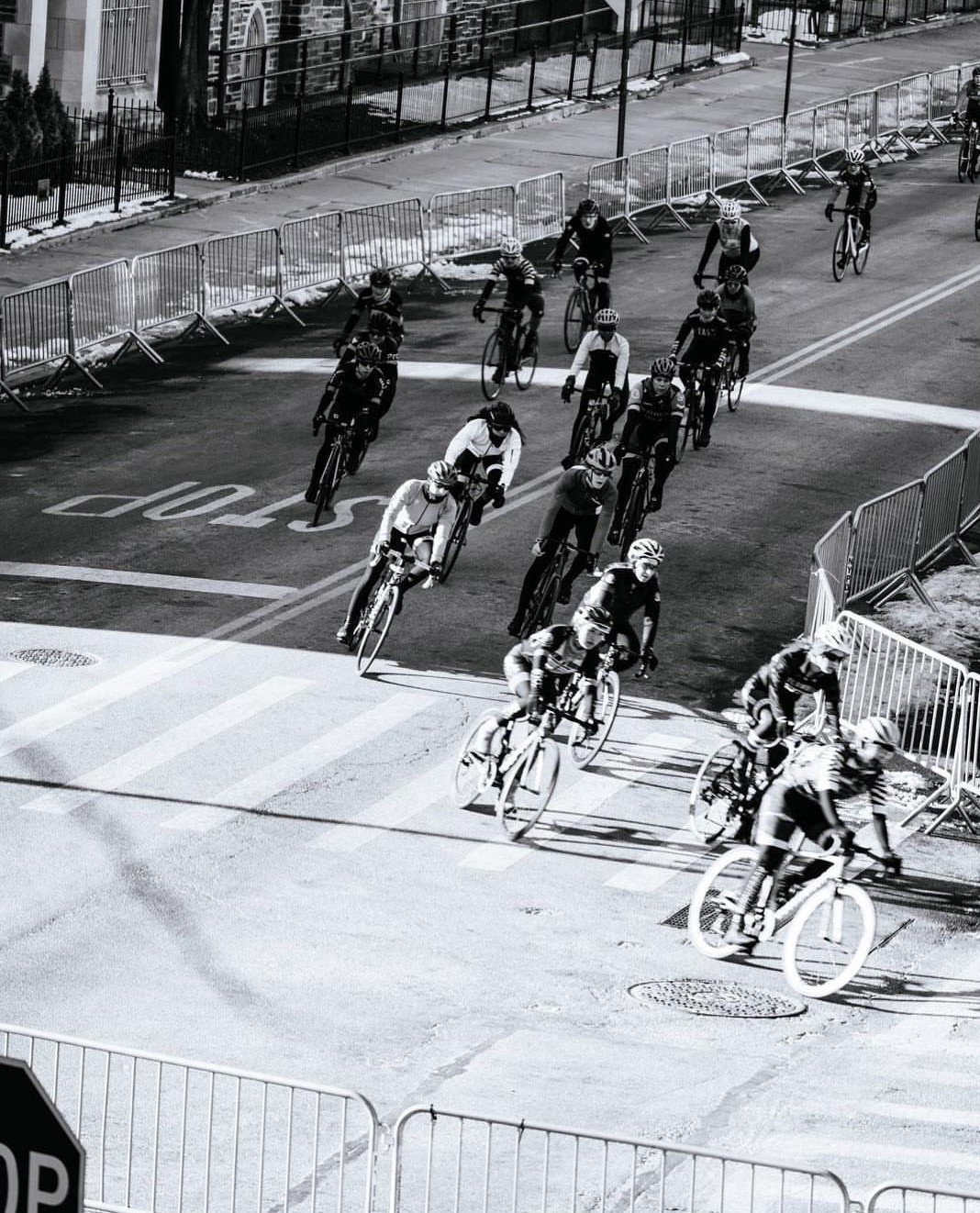
Fast forward to yesterday, and I’m back at the start line of Grant’s Tomb. The nerves were there but this time I felt more positive. I’d realized how strange it was that I used to have no problem killing myself in a 10k run race – in fact that was my favorite distance – but somehow on a bike I felt so much less “comfortable with uncomfortable”. I set myself two mantras for the day – “stay positive”, and “just like a 10k”. Combined with a year’s additional race experience, I did much better, not placing but staying near the front all race, taking corners smoothly, and only falling back on the last couple laps as I didn’t quite have the strength to stay in contention for the sprint.

I left happy! More importantly, I left wanting more. Eyes up look ahead? –no problem in a crit, easiest ask ever! I love how crits force you into the present so that all your senses awaken; and how they force you to breathe efficiently so neither your body nor nervous system crash. I love how technical it is and how every lap you get to figure out how to improve just that little bit more. The only price for admission is, as Steve Cullen from ButcherBox Cycling puts it in the funky short American Crit, “you just need to work so hard you wanna die”.

Grant’s Tomb Crit – I’m near the front and smiling

I love how this kind of race is so at home in the urban environment. I showed up at two more crits last year – Orchard Beach up in the Bronx – a chance to get some springtime sea air, and Lime Rock Grand Prix, a super fun course up in Connecticut. I got a kick out of the fact that’s a real car racing track – especially when I flatted and took a pit stop, where a mechanic changed out my wheel and pushed me back into the race! I’ll be trying a few more local ones this year, and I really hope Red Hook crit gets revived in 2020 for spectating purposes. There’s clearly a rich history of crits and a vibrant race scene in the U.S. that I’d love to see more of.

Teammates on the battlefield. The setting can’t be beat

As far as race goals are concerned, I developed well enough over the last year to go from “off the back” to “in the game”. This year I hope to progress to “in sprint contention”. My limiters are still fairly all-encompassing at this point:

  • 30s/1min power;
  • Sprint technique – I have a vague idea what to do but no experience and never practiced;
  • Improving my mental ability to push hard on a bike – even if my legs are learning to crank out higher power, my mind is still stuck in what I’ll call “Ironman mode”, where pacing is king and there’s really no need for a sprint finish, and certainly no need to go sprinting like a maniac in the middle of a race…

I also look forward to getting good enough to participate in the same race category as my teammates!

On the fun side, reading about Red Hook Crit, and more generally learning about track racing as part of my coaching study, has led me to sign up for an Introduction to Track Racing Clinic at Kissena Velodrome later this month. Give it a go, why not – and I’ll have to try at least one race after that.

Destination Tucson: why bike camp?

I know I’m supposed to be keen into anything and everything cycling, but the words “bike camp” fill me with dread. Yes, great base training bla-di-bla, but the night before leaving, I wondered what on earth I was doing. I’d willingly signed up for 7 hours of flying with all the uncertainty of connecting flights and 300 bucks worth of bike transport fees, to go bike for 3-6 hours a day for 5 days straight, including an ascent of Mount Lemmon. In a desert. Why? No really…so, I kept a mini diary in case it shed light on the matter.

Day 0

Glad I arrived early; I get to decompress although I want to try to build my own bike instead of waiting for the coaches to help. I’m mechanically challenged, but I get out my Ratchet Rocket Lite NTX and “give it a go”. I’m OK until the handlebars which take me 30 minutes with my husband on speakerphone and me sending him photos, “Does this look right to you? What are these long screws for?” Finally, success! Nice bit of confidence boost. I take a glass of wine and watch the sun go down.

Day 1

60-mile loop around Tucson. Nothing too hard to start with, it’s a perfect chance to wind up the legs and get to know my fellow riders. It’s great one of my teammates came; also, a couple ladies from a “rival” women’s team in the city – always happy to get to know my fellow racers better. Determined to save my legs I practice smooth drafting, but I keep gapping around corners and manage to spend 45 minutes in zones 4-6. Coaches take us through cornering skills at end of day to ready us for the descent of Mount Lemmon tomorrow; that’s a nice reminder but now I’m just worried about the ascent and then hanging on another 3 days.

Day 2

90 miles including a 7000ft ascent of Mount Lemmon over 29 miles. My coach can tell I’m nervous and he babysits me the first 10 miles, making sure I stick to zone 3 and distracting me with some good bike conversation. He leaves me in good spirits, but by the time I make it to our halfway SAG stop, I’m suffering. My breathing is ragged, I feel nauseous and can’t figure out why, and I’m upset because I seem to be going slower than last year. Coach 2 is biking up and down the mountain to check on everyone, asks if I’m OK, am I hydrating, eating…I tell him I’m fine and then I walk away from the van to hide a full-on anxiety attack. I tell myself to stay positive and just get the f*ck over it and with that in mind I start climbing again. A few minutes later I’m back with my coach, sitting on his wheel trying to find my own rhythm from his steady pace. But despite my best efforts I feel worse and start to slump over my bike. I make it to 8000ft before pulling over and crumpling on the asphalt, too short on breath.  

Coach helps me stand and gets me to box breathe. That calms me but I still feel sick as a dog. My teammate pulls up too and checks I’m OK, she’s ready to sabotage her own day and come back down with me if needed, but Coach won’t leave me anyway and we descend together.

Turns out to be the best descent I’ve ever made. Keen to salvage some biking joy from the mountain and with the cornering drills fresh in my mind, I push the nausea to one side and start hammering, playing around with the feel of controlling my lean and the lines. Maybe I’ll throw up but at least I’ll do it smiling.

At the bottom, Coach gets me to hydrate and then we pedal home easy together, sometimes chatting, sometimes him pulling me through the headwinds. If he was ever worried in all this, he never showed it.

Altitude sickness – who knew? There’s another notch of experience to put on my belt. Best ride fail ever.

Day 3

Today is scheduled for the Tucson shootout followed by a climb up Madeira Canyon, but I’m still feeling sick so I get some extra sleep & pedal easy for a couple hours by myself, exploring downtown. With the sun on my face and no pressure on pace I finally start to relax. There’s a coach’s roundtable discussion in the evening where the camp mechanic talks about learning to listen to your bike as closely as you do to your body. That’s gold dust advice right there; it makes me appreciate how much of a bike novice I am right now; I vow to improve.

Day 4

I wake up chipper and ready for some fun! The day’s ride is 70 miles to Saguaro West and do the 8-mile loop a few times. I follow the coaches around…we talk cornering and crit skills and what I can work on to stay smooth and use less watts. Then I sit in a close draft and make them bike really fast so my pigtails go flying behind me and I’m still barely working. Just like a playground ride!

Day 5

50 miles around Saguaro East. Yeah, I’m done – this is Eyes Up, Look Ahead and Bike Slow day. Actually, these cacti are growing on me. I’m from Wales and more of a rugged-green scenery kind of girl, but I finally start to appreciate the otherworldly beauty and how the stark difference to my usual NY routes feels refreshing to my mind. Today has a bike touring – not training – feel.

Conclusion

Why bike camp? Because it was a great learning experience; it has super-experienced coaches and a mechanic who are skilled at spotting and handling any kind of issue effectively without drama; it teaches you to get through that tunnel of fatigue and out the other side and still be pedaling strong; because a forest of cacti is actually pretty cool and because it captures everything that biking should be.

Thanks to enduranceWERX for a smashing bike camp.

Prehab not Rehab: a simple program to avoid injury and generate more power

Imagine you have the choice of purchasing two used cars. They’re both the exact same type, engine size and age, but one has been serviced more than the other – for example it has better wheel alignment and the pistons and sparkplugs are less worn. Naturally, we would choose to buy the better serviced car as the risk of breaking down is lower and we’d expect a more efficient use of fuel. So, why settle for less when it comes to our own body?

In human equivalent, we’re talking about the movement of joints and soft tissues – muscles and fascia. If those tissues are tight or become scar tissue through traumatic, repetitive motion or overuse injuries, they will be less efficient at storing and releasing energy. That means less watts.

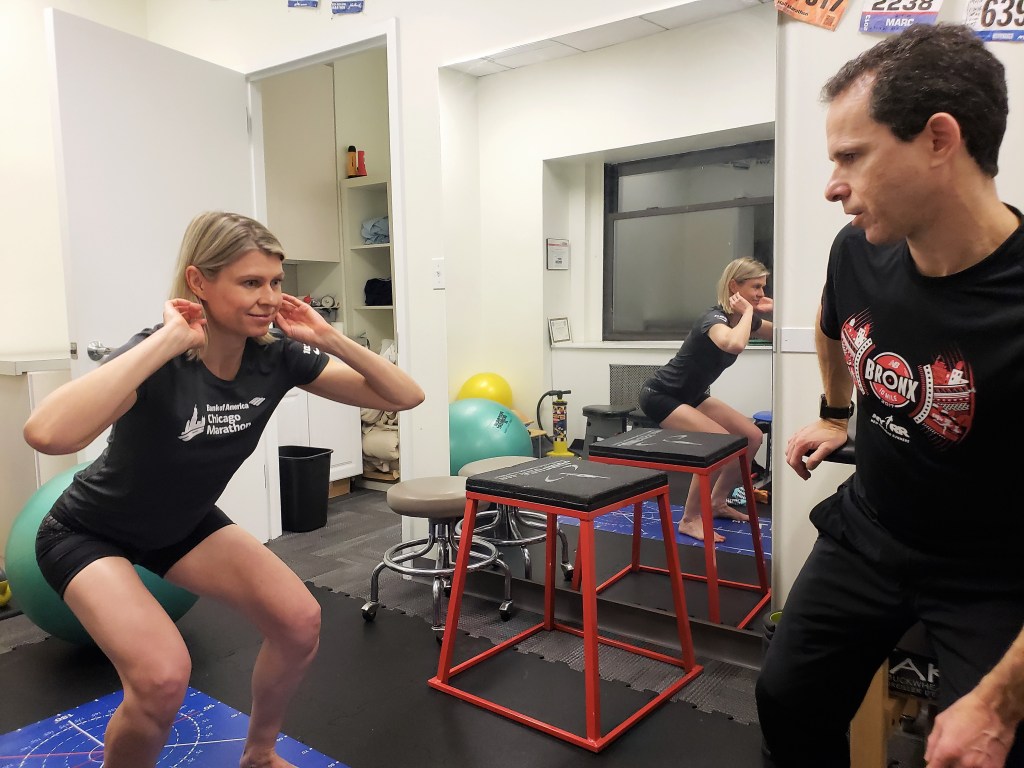
As members of a bike team that would quite prefer more watts than less, my teammates and I enlisted the help of Dr. Marc Bochner from Bochner Chiropractic to teach us a solid prehab routine. Marc has been treating amateur and professional athletes in the NYC area for over 20 years. I’ve personally needed him so much that I wouldn’t still be training without him; our resulting friendship has been a major upside.

Prehab(ilitation) refers to the self-care routine we can follow on a periodic basis to monitor and treat our weak links, before injury takes place. Depending on the state of our bodies, such routine can require a series of professional treatments, or simply take 10-15 minutes before each workout. Marc has developed a program called Prepare to Compete that provides athletes with a simple but structured approach to such injury prevention. This program is designed to maintain and/or improve three key areas, as follows.

Posture (also called form)

Good posture implies that the body at initiation of movement is in a strong, balanced position. The key limiters are tight or injured muscles so key protocols here are:

Testing for tightness – doesn’t look wonky to me

Range of motion (also called tension, flexibility, or mobility)

Good flexibility means that we can move muscles and joints through their full range of motion such that force production can be optimally converted to power. One often-overlooked aspect of this is our breathing – without proper breath technique the deep stabilizing muscles won’t activate; furthermore, poor breath technique can reinforce poor posture and muscle tension. Self-care exercises should include:

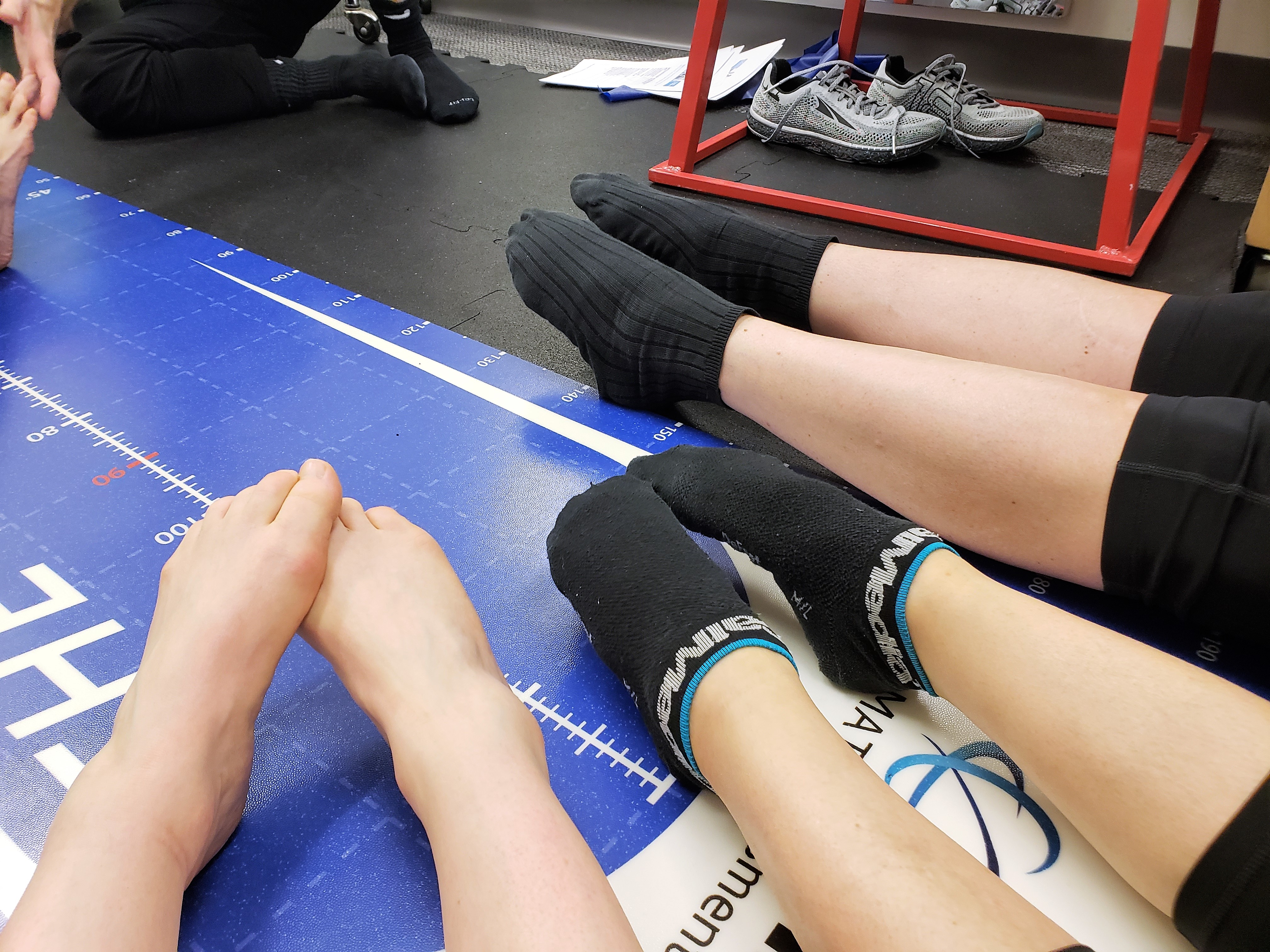
With this awesome amount of flexibility, we could be a swim team

Movement control

A high quality of movement control implies efficiency of muscle recruitment. For example, when you move your leg backwards from the hip, the gluteus maximus and deep core should contract first, not the superficial lower back muscles. This avoids excessive strain on a single muscle which was not designed to carry out that movement in isolation; it also means greater force production. Seven key exercises require maintaining the first two concepts above through movement:

  1. Rocker board balancing
  2. Single-leg standing (with or without eyes closed)
  3. Standing knee hug
  4. Lunges (front, side, rear, front with rotation & oblique)
  5. Side raises
  6. Single leg squats
  7. Push ups
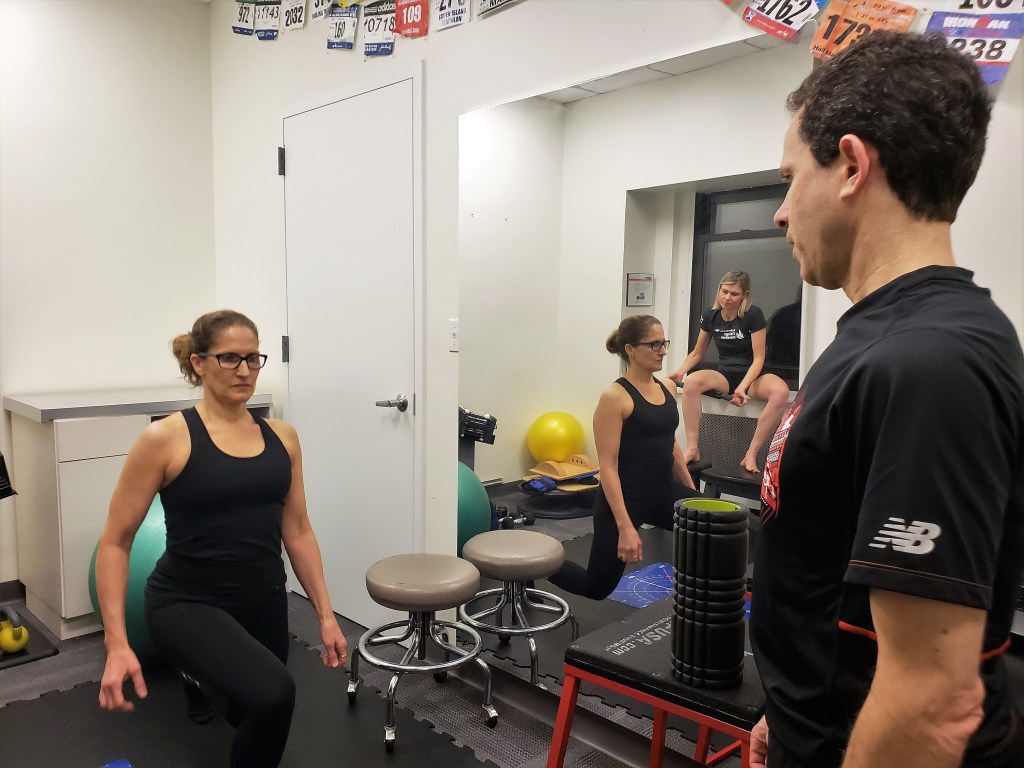
The perfect lunge by a kick-ass sprinter

How prehab links to bike fit

I can’t explain better than this blog post from Fit Werx. Posture breeds comfort; flexibility aids aerodynamics; movement control generates power.

Positive reinforcement through daily activities

A key point I often forget is that while it’s all well and good to practice good movement patterns as part of our workout routine, about 90% of our days is actually spent doing other stuff, and that other stuff often involves a lot of sitting or standing around with plenty of room for reinforcement of bad postural habits.

  • The dangers of sitting have been well documented. Luckily Marc provides some handy desk exercises that can help without looking too silly.
  • A bus or subway commute is also a great time for a few exercises:
    • reinforce good posture by fully engaging the core and upper back muscles
    • stand on one leg for 30 seconds at a time
    • practice glute engagement (squeeze your butt)

You never know, that last one might also land you a date.

How To Train Your Husband, Part II

In How To Train Your Husband, Part I, I describe how I set out to use my husband as a coaching guinea-pig for a month. The idea was to get him back into training and to give myself a sense of what being a coach would be like. In this post I look back at the results and figure out lessons learned.

Did we achieve his objectives?

Yes – pretty much, sort of!

Obj. 1 – Achieve some consistency of training again – specifically, two workouts per week for each of swim/bike/run and strength.

              We got there! The first week we missed a swim and run but got consistency the next two weeks. The final week was derailed by a cold. Overall, 72% of workouts were completed. All credit for this goes to my husband, who re-evaluated his working hours to make time for working out.

Obj. 2 – Complete swim workouts of no less than 30 minutes each, and be able to swim 500-600m steady continuous

              Achieved! First swim, he came back saying that every lap felt like hard work. Last swim, he completed 1500yds including some 50’s at a harder effort, and “felt good”.

Obj. 3 – Be able to run a minimum of 5 miles continuously, i.e., no walk-run

              Nearly! We got to 5 miles with breaks for stretching. We did get out of the “this hurts and I have to walk now” mentality, and whereas week 1 I got a frowny face as comment, by week 4 I got the happy face. Turns out the mantra we put in place, “one step at a time”, was hugely valuable here, as was ensuring time set aside for proper warm-up.

Obj. 4 – Do not, under any circumstance, buy cheese

              Fail! Mostly because when it came my turn to cook, I bought pizza. Naughty coach.

The nicest part for me was to see how the motivation grew over time, with one small workout success feeding the next. As example, the first early morning strength workout I’d planned, I laid out his kit the night before, set the alarm, made coffee, dragged him out of bed, and went through the routine with him one exercise at a time. Fast forward to week 3…an hour after the alarm goes off, I stumble into the living room to find him standing on one leg surrounded by different color resistance bands, telling me to “stop talking, I’m in my focus zone”. Nice, hon!

Which brings me to the one argument we had…it was single-digit temperatures outside, and he came home early evening having worked outside, had a bad day, then got his muscles kicked by our ART practitioner.

“Doctor worked my muscles, so I can skip my swim, right?”

“No. He worked your legs. Swimming uses arms. You should get to the pool now.”

In the ensuing argument, the funniest thing was that I couldn’t tell if he was upset at me because I was his coach, or his wife…if I kick you out the door at 8pm to go swim in 5-degree weather, is that tough love coaching or just being a crappy wife? In this instance it happily turned out to be the former, as he finally left to get it done and came back with a smile. Phew.

I forced my husband to get to the pool no matter what

Lessons learned

  1. Coaching is hard! Kudos, coach-people
  2. The critique from my husband was that I did not allow for enough rest days. In particular, as we ended up going away for a weekend I took away his usual (Monday) rest day to shoehorn in the required number of workouts, thinking it was do-able given the relatively easy workout schedule. That was a mistake because a) I was under-estimating the cumulative muscle fatigue associated with the run workouts; and b) I was not factoring in that recovery days shouldn’t just be for muscle recovery but also for mental recovery and general rest & relaxation. Unsurprisingly, that mirrors the same mistake I make with my own training
  3. You can’t impose what you would do on other people. The right “pace” of progression is unique to each person, and you need to meet people where they are. For example, I put structure in certain workouts to give a boost to fitness gains, but my husband didn’t always want to do them and I couldn’t talk him round
  4. In a similar vein, it seems important to give people space to figure out what works for themselves. My instinct is to try and be helpful, when the reality is that I’m just being overbearing…there’s a fine line between guiding and imposing that I find hard not to cross.

And finally…I really like coaching. Time to study!

What’s the “right” amount of muscle fatigue?

Of all the training questions I’ve had over the years, this one has plagued me the most in one form or another. I’d have these beautifully laid-out plans of run, swim and bike workouts all spaced out perfectly for recovery purposes, and then I’d remember I had to get strength in there somehow and the whole week would get screwed up. Was I supposed to do that the same day as a hard workout? Next day? How many reps?

Up until last week I thought I’d got that figured that out. In my running and triathlon days, endurance was the name of the game. The objective of strength work in the gym was to buffer against injury and increase resistance to fatigue. This is also called building “muscular endurance” and is typified by sets with relatively higher reps and lower weights. Coming into workouts with some muscle fatigue is normal, provided recovery is adequately accounted for.

Such strength work fits in nicely with a classic pyramid training plan which starts with a “base” period where you build your basic fitness – get an aerobic base, build strength as described above, and work on “speed skills” i.e. sport-specific drills where you work on technique and cadence to help you gain efficiency. As base progresses to “build” and “race” phases, longer and/or harder sport-specific workouts take precedence, and strength work in the gym goes on the back burner. I’d normally find that during springtime I’d hit a week where I’d get really fatigued trying to do a lot of everything and crash. This was my signal it was time to cut back strength to once-a-week maintenance. Perfect.

This off-season however, three things are different. First, I’m bike racing, not triathlon-focused. Second, I got flexible and strong enough to start lifting some proper heavy weights. Third, my coach flipped the classic pyramid on me. This means we’ve been working on my limiter – the short end of the power curve – with hard interval workouts during my “base” period.

Always the one to push, of course I tried to “Keep Calm and Do Everything”. I need to do strength or I’ll be weak! Going into hard intervals fatigued? Well that’s normal, isn’t it? Doesn’t that just mean I’ll ultimately be stronger? I checked with my coach and my trainer.

Coach (still getting used to me): “Uhhhhh no, I need you fresh for the hard stuff. Sorry…why did you put an extra strength workout in your plan?”

Trainer (known me for years): “No. LOL, you always try to do too much, you’re hilarious…”

OK then…time to go away and figure out where my thinking went wrong. Here’s a summary of what I learned.

Wikipedia defines muscle fatigue as follows: “Muscle fatigue is the decline in ability of a muscle to generate force. There are two main causes of muscle fatigue: the limitations of a nerve’s ability to generate a sustained signal (neural fatigue) and the reduced ability of the muscle fiber to contract (metabolic fatigue).” Metabolic fatigue is caused by two main factors: shortage of fuel and/or accumulation of metabolites (e.g. lactic acid) within the muscle fibers.

Strength can be defined as the “property of a person or thing that makes possible the exertion of force or the withstanding of strain, pressure, or attack”. Strength training is about developing the ability to generate force. That force can be generated by one or more of three types of muscle fibers: “slow-twitch” – Type I, or “fast-twitch” – Types IIa and IIb. Essentially, slow-twitch fibers use oxygen for fuel – i.e. they work “aerobically” – and this type of fueling allows the fibers to generate a moderate level of force for a sustained amount of time. Put another way, they are recruited when muscular endurance is required. Fast-twitch fibers use stored muscle glycogen for fuel instead of oxygen – i.e. they work “anaerobically”. Anaerobic fueling allows the fibers to generate high-intensity force, but only for a short period of time. They are recruited in order to generate power. Fast-twitch fibers only contract once the slow-twitch fibers have fatigued.

The percentage of each type of fiber in your body depends on both genetics and how they are developed in workouts. As explained by my trainer: “different strength workouts are specifically measured by Time Under Tension, Duration, Repetition, Load, and Speed. Relying on these measurements illustrates how the workout is defined and which muscle fibers you’re firing off.” The table below summarizes the differences between them in more detail.

Characteristics of muscle fiber types

Characteristic Type I Type IIa Type IIb
Contraction speed Slow Fast Fast
Resistance to fatigue High Medium Low
Force production Low High High
Glycolytic capacity (ability to produce
energy in the absence of oxygen)
Low High High
Oxidative capacity (ability to use oxygen
as fuel)
High Medium Low
Recruitment during sport Endurance Mix Power

Going back to the original question, then, where was my thinking going wrong? – Essentially, I was confusing the development of endurance and power. Type II muscle fibers won’t fire when they are fatigued, which means that if I head into an interval workout with sore muscles, I will recruit more of the Type I rather than Type II. This isn’t an absolute – depending on level of fatigue I may end up using some percentage of all types – but if the objective of the workout is to train power generation, it’s definitely less effective.

There is some nuance when it comes to putting a training plan together. One thing that I did notice and is apparently a common experience, is that I can cope with two hard workouts on back-to-back days with only a small loss in power. After that I’m toast, but provided I get adequate recovery before the next hard session, it’s OK. Again reviewing this with my trusty coach/trainer team, it seems this ability to cope with back-to-backs is really personal to each athlete. I’ve been training for many years now so maybe my overall resistance to fatigue has developed over time. In addition, one needs to consider the cumulative impact of workouts, not just what you did the day before. Two hard days at the end of an intense training block likely feels quite different than at the start.

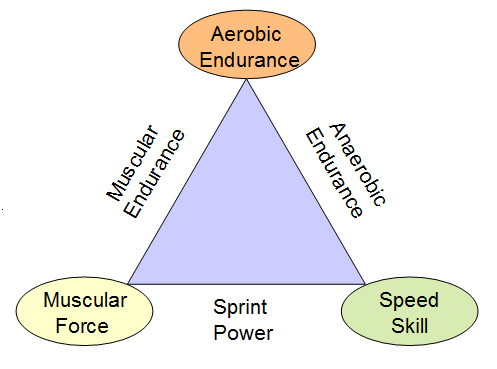
All the concepts above come together nicely in the diagram below, which is the well-known “6 abilities” triangle as used by Joe Friel in his Training Bible books.

Each of the advanced abilities shown on the sides depends on the basic abilities shown in the corners. In particular: muscular endurance lies between the development of force and aerobic endurance. It’s the capacity to maintain a relatively high force for a relatively long time. Muscular power lies at the intersection of force and rpm – Force * Cadence = Power.